

Safety is your top priority. This also applies to the machines you have engineered and built. Perhaps you rely on the CE marking as a guide in this area—proof that the machine in question complies with the Machinery Directive. But machine safety goes beyond this marking…
First, a little theory.
Since 1995, as a machine developer and manufacturer, we have been required to comply with the Machinery Directive. This is a European directive that imposes essential requirements on machine manufacturers. These requirements primarily concern safety and health. For example, we are required to prepare a design dossier. This dossier must demonstrate that the machine we have manufactured complies with all of these European requirements.
The idea behind this? That within the European Union, no additional inspections or checks are required when a machine manufacturer from country X supplies a machine to a company in country Y.
This simplified administration, combined with a greater focus on machine safety, is a good thing.
Now for the actual practice.
Descriptive, not prescriptive
Because the CE marking on a machine is not a guarantee of safety. It is not a 100% guarantee of 100% machine safety. There are too many gray areas in European legislation for that.
For example, the requirements set forth in the Machinery Directive are fairly basic and describe general principles. The specific details of how those general requirements are to be implemented can be found in the European Standards. For instance, there are more than 700 standards linked to the current version of the Directive.
However, unlike the requirements set forth in the Directive, these are not mandatory. Rather, they describe the rules of good workmanship for the machine builder. It is up to the manufacturer to decide what to do with them—and what not to do. They also provide additional legal protection in the event of a notice of default or a lawsuit.
CE Marking: Manufacturer and Review Panel
That brings us to the second reason to look beyond the CE marking on a machine. Who do you think decides whether or not a machine is certified? An independent certification body?
Miss.
With the exception of a few types of machinery (Annex IV of the Machinery Directive), the manufacturer affixes the CE marking to the machine itself. So we are both the manufacturer and the judge. It’s a strange situation. It’s like asking a film director to write a review of his latest movie. Or being allowed to fill in your own evaluation during your next performance review.
We at IMA assume that most machine builders do everything in their power to deliver a machine that is completely safe. But experience has taught us that there are still manufacturers who do not address the issue of machine safety properly. Not out of malice, but because they lack sufficient in-house expertise. Or because the bare minimum is enough for them: the machine is CE-compliant anyway, so why go to the extra trouble?
Greater certainty
Would you like more certainty? If so, discuss this important topic with your machine manufacturer. Ask how they handle machine safety and where and when they address it during the engineering and assembly phases.
This way, you can avoid working with a manufacturer who only focuses on the basics of CE marking—one who views safety merely as an afterthought.
Because machine safety is too important to be addressed only after the prototype is already up and running—as we often see in practice today. This aspect begins right from the design phase, with an initial risk assessment that helps determine the choices regarding materials, design, and operating principles.
Multidisciplinary
We always take a multidisciplinary approach. For us, the first step toward a safe machine is the combination of the specific expertise of our mechanical engineers, process engineers, electrical engineers, and control engineers.
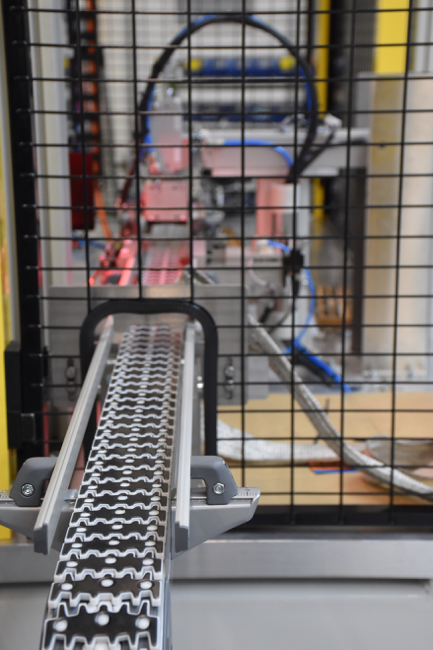
Then, in the next step, focus on the visible elements, such as mechanical guards, as shown in the photo above, or control-related safety circuits.
Do you have any questions about CE marking or the safety of your current machinery? We’re here to help.