
CASE
BRAZING MACHINE FOR DAIKIN


CHALLENGE
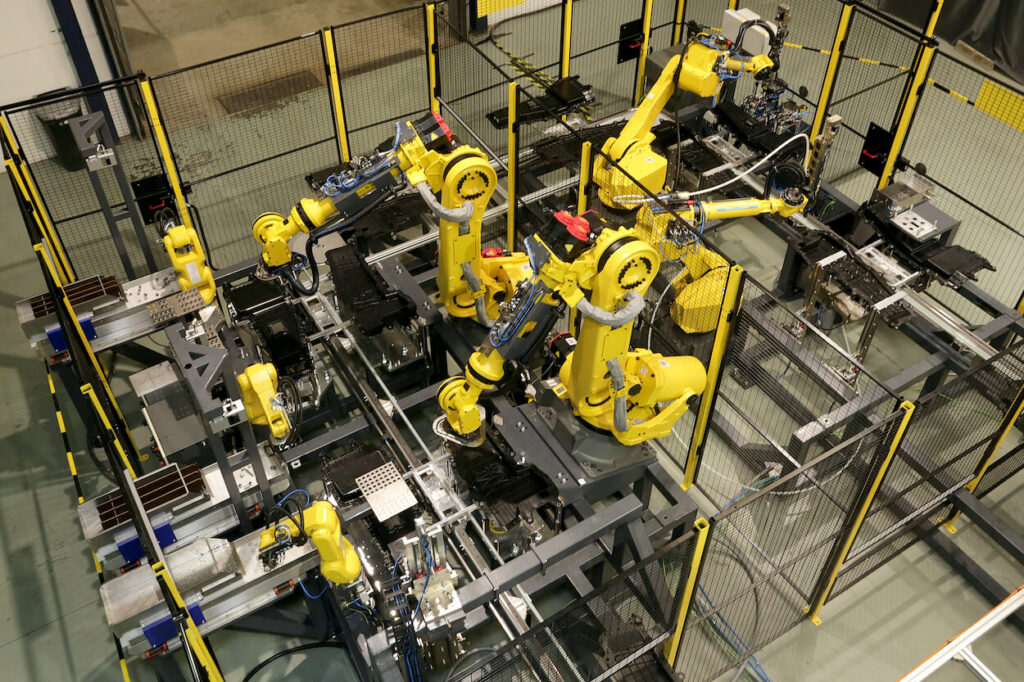
Brazing or hard soldering is a precision task that requires craftsmanship, attention to detail, and good hand-eye coordination. We engineered and built a brazing machine for Daikin that automates that craftsmanship.
Daikin specializes in heating and cooling. The Japanese multinational develops and manufactures products such as heat pumps, boilers, and air conditioners. For air conditioners, brazing is an important part of the production process. This is a joining technique in which two metal materials are heated to above 450° C so that a liquid filler material can flow between them.
The result is an extremely strong connection. At Daikin, these are the connections in their heat exchangers, also known as coils. These are the tubes inside the unit that contain the coolant.
SOLUTION
Brazing is a specialized craft. Yet skilled technicians are hard to find. And Daikin offers no fewer than 14 different models of heat exchangers. Add to that a massive spike in production during the summer months and a decline during the colder months.
The bottom line is that automation was a natural step for Daikin. It would allow them to be less dependent on the labor market, produce more consistently, and improve the quality of their products.
Less obvious: How do we translate that human craftsmanship into an automated process?
We engineered and built a brazing machine, integrated onto an existing conveyor, which is part of an automated line. It was nice to see it again, since we also engineered and built that line. The brazing cell is incorporated into the safety and control system of this line.
Brazing Machine: The Process
1. Handling and Identification
The conveyor feeds the coil.
The photoelectric sensor detects the start of the coil and signals that the conveyor's drive motor must stop.
The scanner reads the barcode label. It then transmits that information to the PLC.
Based on that information, the PLC selects the appropriate braising program.
2. Set up
The exact steps depend on the type of coil.
For long coils, the conveyor carries the element further.
When the coil level is low, the elevator brings the coil up.
The back of the coil is clamped by a pneumatically driven beam.
3. Detecting burn marks
A camera mounted on a longitudinal slide scans the area where the tubes are to be brazed.
The vision system calculates the positions of the tubes to determine the brazing points.
The PLC compares the theoretical pattern with the actual visualized pattern.
4. Braising Cycle
The brazing robots move from their rest position to the first point and start the
brazing cycle.
They heat the material to above 450° C using induction.
They fill the opening with flux.
The brazing robots are each completing their cycles.
Afterward, they return to their resting position.
5. Execute
The elevator moves downward and transports the coil to the discharge position.
The conveyor starts up and transports the product from the brazing machine to the next conveyor.
Is automation the logical next step for your business as well? But is there no machine on the market that does what you need it to do? Please contact us.
CASES
OVERVIEW OF OUR CASES