CASE
EXISTING LINE BECOMES FUTURE-PROOF

CHALLENGE
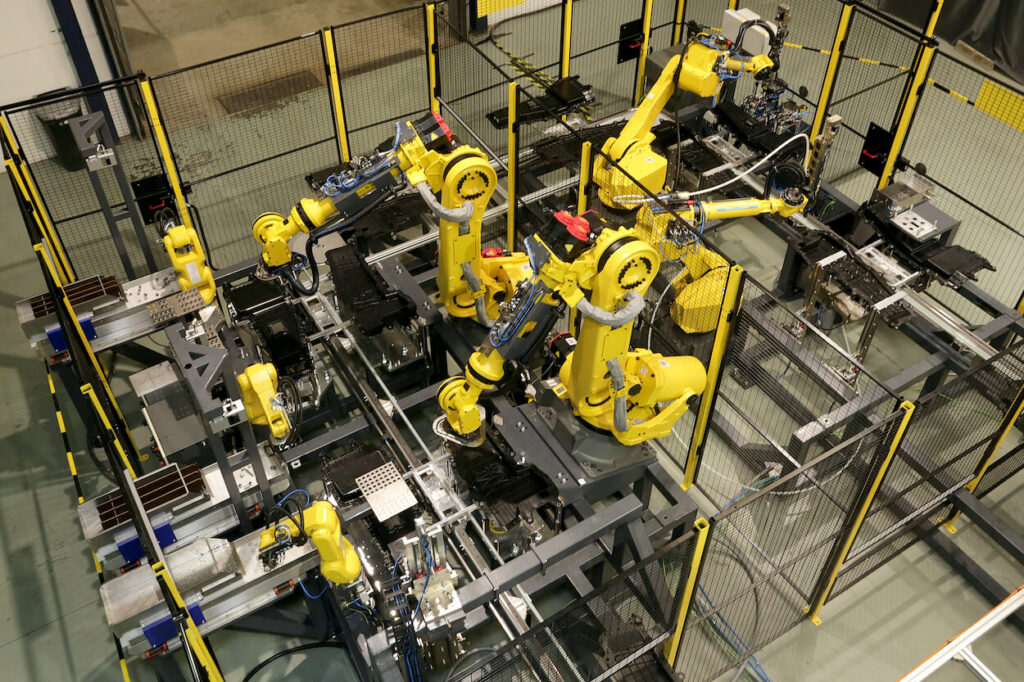
One of the production lines at Vlevy, a manufacturer of toppings for the food industry, underwent a major update and upgrade by IMA. As a result, the line is now fully ready for the future!
This line fills laminated bags with 5 kilograms of mixed meat, which are then vacuum-packed and sealed. The filled bags are then ready for the next line, where they are cooked.
The customer set the following objectives: increasing efficiency, reliability, production capacity, and ergonomics. IMA developed solutions to relieve the machine operators of labor-intensive work, as well as provisions to increase production capacity in the future.
At the same time, we tackled a number of vexing problems. For example, if the welding bar failed, the entire production line would come to a standstill. And the metal workpiece carriers made a deafening noise when they bumped into each other during transport—a “detail” for which IMA also found a solution.
Additional challenges:
- Comply with the strict hygiene standards in the food industry;
- The software had to be able to communicate with the existing machines;
- A vacuum container weighing 1,200 kilograms is suspended on the production line. When the contents are evacuated, there is a risk of implosion;
- The stainless steel plates of this vacuum tank are 20 mm thick and 3 m long. Experts know how quickly stainless steel warps …;
- In addition, for hygiene reasons, the floor in the production area slopes downward, while the machine must, of course, be level.
In short, this was a project in which our electrical, automation, and mechanical engineers worked closely together to improve both the production process and quality.
Better quality and a better process thanks to close collaboration between electrical, automation, and mechanical engineers.
SOLUTION
For this complex project, we proceeded in phases.
The line starts at the existing filling machine (not designed by IMA), which communicates with the IMA line’s software. The filling machine fills bags with 5 kg portions. The filled weight is then
checked, and bags are ejected from the line if there are significant deviations.
In addition, IMA came up with the idea of adjusting the shape of the bags after filling. This significantly improves the seal quality. In consultation with the customer, we also found a practical way to push the last bit of air out of the bag before applying a vacuum and sealing it. The result: a better seal and greater control over the product. The overall quality is higher.
The existing sealing machine, which had 6 feed containers mounted on a single long sealing bar, turned out to pose a high risk of bringing the entire line to a standstill. IMA replaced two sealing machines, each with one long sealing bar, with a single machine featuring eight separate sealing bars that operates faster. The major advantage of this setup is that every bag is sealed identically. Previously, the bags in the middle of the long bar were sometimes not sealed properly.
A great deal of time and attention was devoted to the vacuum chamber. Despite its weight of 1,200 kilograms, we opted for a suspension system for hygiene reasons. Precise calculations are designed to prevent it from imploding when the vacuum is applied. Our welder succeeded in welding this chamber, made of 20-millimeter-thick stainless steel plates, perfectly straight.
Next, we move on to the bag remover, where the filled and sealed bags are removed from the workpiece carrier two at a time. They are conveyed on a second belt to the operator, and the workpiece carrier is returned to the filling machine. The operator places each bag into preformed trays (which are later boiled).
Of course, we took all the specific regulations of the food industry into account at every step.
Increasing Production Capacity
The line was designed to increase production capacity by 60% in the future. Not only did we expand the line from 6 to 8 containers, but we also efficiently coordinated the speeds of the successive steps. If part of the line comes to a standstill, we ensure that the production capacity for that day is still met. Each link in the line is individually adjusted so that the next one always operates slightly faster than the previous one. Specifically: the bag retriever runs faster than the sealer, the sealer faster than the preformer, and the preformer even faster than the bag filler. If a stoppage does occur, this buffer ensures that the entire line can be restarted
quickly.“This production line involves multiple machines running different types of software. We’ve succeeded in getting them all to communicate with Vlevy’s existing machinery.” – Zoë, automation engineer
ADDED VALUE
In addition to the established objectives, we have proactively sought further product improvements through the use of a seal solution that eliminates residual air and the pre-forming of the bags. Our machine design is also geared toward potential capacity increases in the future. Thanks to automation, the work is less physically demanding, and three employees can now be assigned to other workstations.
CASES
OVERVIEW OF OUR CASES